
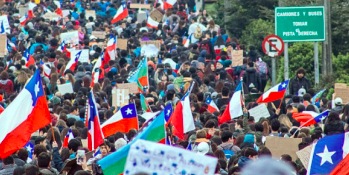

Chile’s national plebiscite, a response to the country’s 2019 protests, will ask voters whether the country’s constitution should be rewritten. // File Photo: Natalia Reyes Escobar via Creative Commons.
Chile will hold a national plebiscite on Oct. 25 on whether to rewrite the country’s 1981 constitution. How is the vote shaping up, and to what extent has the economic and social aftermath of the coronavirus pandemic influenced voters? Is turnout likely to be low because of health concerns, and how might that affect the result’s legitimacy? What’s at stake in the referendum, and are protests likely to ensue after the vote?
Claudia Heiss, head of the political science program at the University of Chile’s Institute of Public Affairs (INAP) and researcher at the Center for Social Conflict and Cohesion Studies: “Chileans have consistently shown a strong preference in favor of replacing the 1981 constitution, as well as for doing so with a constituent body that is completely elected, as opposed to one composed of a 50-50 mix of current legislators and elected representatives.
Data differ, however, on the extent to which the pandemic may reduce Chileans’ willingness to vote, from 79 percent according to Data Influye to only 53 percent according to Activa. Fear of contracting Covid-19 and a relative decrease in immediate concern with constitutional change before new health and economic urgencies may reduce turnout. Preference for a new constitution has consistently exceeded 70 percent. There is also a clear preference for an elected constituent convention over the mixed formula, although the difference between these options is smaller than those who want and don’t want a new constitution, 66.8 percent versus 28.1 percent, respectively.
What is a stake in this plebiscite is the strength of a symbolic mandate for deep structural reform and a message to a political elite that has maintained key institutional aspects of the political and economic model imposed by Pinochet. Protests are likely to continue throughout the constitution-making process, which ends in 2022. But the degree of openness and inclusion of this process will determine the intensity of protests, as well as the relevance of a discredited political establishment and its capacity to channel social demands».
Daniela Jara Leiva, professor in the Department of Sociology of the University of Valparaíso: “Chileans are demanding a major transformation. Universal access to better education and pensions are among the main demands, but the social movement is also fueled by a general malaise toward a political elite that seems disconnected from people’s needs, problems and realities. A concept that demonstrators have used to summarize their criticisms is ‘dignity.’
The 1981 constitution, its authoritarian origins and its conservative mechanisms have been criticized, as has as an increasing delegitimization of social institutions and their legal framework. Constitutional change is not a new social demand; it was part of Michelle Bachelet’s campaign promise. Today, just a few weeks from the plebiscite, it seems that Chileans will approve a rewriting of the constitution, although the pandemic will complicate turnout levels. However, low participation in referendums (40-50 percent) has been an increasing tendency since voting became voluntary in 2012. Although there is uncertainty, it seems that disapproval of the social order and the demand for social change will win over fear. Expectations are high. Polls are showing that 55 percent to 70 percent of Chileans want a new constitution. It is expected that new voters will participate, particularly younger ones, revitalizing representation despite the pandemic. If Chileans vote for a constitutional rewrite, it seems likely that society will exert Prensaure to improve the mechanisms of representation in the next stage: the election of candidates for the constitutional convention.
I expect politicization of society to continue shaping the debates regarding the contents of the new constitution over the next two years, and that social polarization regarding controversial issues may continue, sometimes exacerbating them. A key issue in the short term will be the representation of independent citizens and social groups in the convention, as well as police reforms. It’s likely that social manifestations will still take place after the plebiscite; a public culture of street demonstration will likely persist during these two years, challenging the maintenance of public order and security in accordance with human rights standards.”