
Publicado en The Times
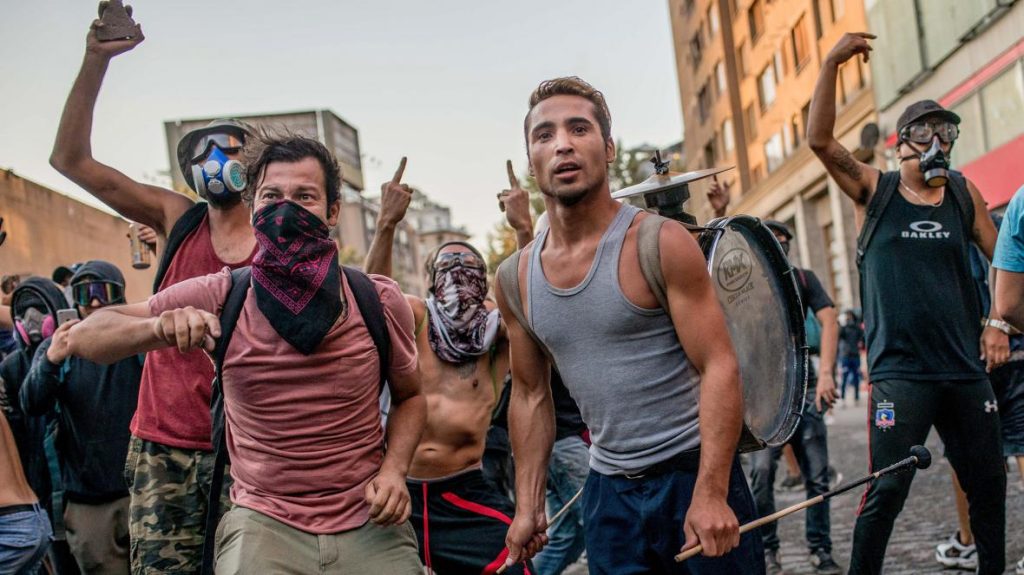
Awhiff of tear gas hung over the central plaza. A group of students sat under the statue of a 19th-century general on horseback that they had painted with their protest slogan: “Victory or death!”
All around was strewn the debris of battle — rocks, tear-gas canisters, an abandoned shoe. Shops were boarded up, buildings and trees scorched by fire.
“I can’t believe it’s come to this — we’re Chile, not Venezuela,” said Esteban Gonzalez, a bar owner pulling down the shutters in readiness for the next battle — “usually around 6pm”, he said.
After a truce during Chile’s long summer holidays, a wave of protest has once more engulfed one of Latin America’s richest countries, with tens of thousands expected on the streets for an International Women’s Day rally today.
What began with anger over a rise in Santiago’s metro fares has grown into a revolt in cities all over the country against its once vaunted “neoliberal” model.
Already at least 31 people have been killed, more than 3,000 injured and 30,000 arrested, in the worst unrest since General Augusto Pinochet’s dictatorship ended in 1990.

Much of the rage is directed against Sebastián Piñera, the embattled, centre-right president, a Harvard-educated billionaire who seldom ventures out of the Moneda palace. He is accused of badly misreading the mood of his country.
“Piñera and those around him don’t understand people’s feelings, the difficulties they are experiencing,” said Cristobal Rovira, a political scientist at Santiago’s Diego Portales University. “He lives in a bubble.”
In the week the protests broke out last October, with tens of thousands of people in the streets, Piñera was photographed celebrating a family birthday at a fashionable restaurant in one of the city’s affluent neighbourhoods.
“He doesn’t understand that society has changed,” said Rovira. “A growing middle class has had access to things they didn’t have in the 1990s, and they are more educated than before and not willing to accept the things they accepted before. People want better health and education.”
As students gathered for another clash with the police, the central plaza looked as though a hurricane had passed over it. Paving stones had been torn up. The entrance to the metro was under rubble.
Amanda Opazo, 19, a student with a pierced eyebrow, said she had joined the protest on behalf of her grandmother, who could not survive on a tiny pension.
“A lot of elderly people like her have committed suicide because they don’t want to be a burden on their families,” Opazo claimed. “Under the constitution designed by the dictatorship, the state doesn’t take care of anything here, not even education or health.”
When dozens of underground stations were set on fire late last year, Piñera declared, “We are at war.” But his deployment of troops on the streets stirred ghosts of the country’s dark past — as did allegations of brutality, rape and torture against the carabineros, Chile’s police.
Ricardo Lagos, 82, a former centre-left president, was shocked by the violence. “We had enough of that under the dictatorship,” he told me.
He recalled how he had fled Pinochet’s coup in 1973, fearing for his life. He went into exile in Argentina just in time for that country’s military takeover in 1976. “I went from one coup to another — the only difference was that the tanks in Argentina stopped at the traffic lights,” he joked.

While Argentina struggled to recover after its dictatorship, its neighbour enjoyed stellar growth under the “market society” inherited from Pinochet. But Chile’s newly middle class now feel bitterly disappointed.
“It’s easier to defeat poverty than it is to satisfy the demands of this new class, who are better off than their parents and want their children to be better off than them,” said Lagos.
Seeking to pacify protesters, the president has revoked the rise in metro fares, sacked unpopular ministers and introduced laws to improve salaries, pensions and healthcare. He also has agreed to a referendum next month on whether Chile should adopt a new constitution. Polls show that the “yes” vote is leading.
If it wins, the vote will be followed by an election for the members of a constitutional convention. Many on the right fear it will be dominated by parties of the left as the public seeks revenge for its woes on the government.
“Since the dictatorship we’ve had the best 30 years in our history,” said Sebastian Torrealba, a conservative MP in Piñera’s party, who accused the left of stirring “social hatred” and violence. He acknowledged that the system had left some behind, but insisted that only “adjustments” were needed — not a new economic model.
Giorgio Jackson, a leftist MP, accused the president of trying to scare people into rejecting a new constitution. “He keeps on saying, ‘We don’t want to be like Cuba or Venezuela’, but we on the left don’t want that either,” he insisted. “We want a new model — but nobody in their right mind would want Venezuela’s.”
As for the famed “neo-liberal” model, its days are done, Jackson hoped. “It was born here and will be buried here too.”